

4 Possible Adaptations for The Lord of the Rings (with reading recommendations and a free, bonus literary analysis!)
With the success of The War of the Rohirrim, season three of The Rings of Power on the way, and the announcement of 2027’s Gollum movie, the Lord of the Rings franchise has begun taking advantage of just how much source material is available for adaptation. Although we don’t know what else is planned for the franchise yet, Tolkien’s broad, open-ended mythopoeia offers enormous potential for film and TV, which I’m going to nerdfully speculate on below.
First, in the following section I give my analysis of why some LotR adaptations work, and others don’t—skip this part if you don’t want the nerdy literary criticism.
Realizing the Myth
Tolkien wrote the lore of Middle-earth (or Arda, since we’re getting nerdy here) in a way that presents difficulties to onscreen adaption, requiring a different, more interpretative approach than with a standard novel, or even other lore-based adaptations like House of the Dragon. This is best seen with The Rings of Power; its mixed reception among casual and hardcore fans alike showcases why adaptations set in the main story preceding The Lord of the Rings (i.e., the struggle of Elves and Men against the forces of Morgoth and Sauron) will inevitably be less successful than side stories like The War of the Rohirrim.
This is due to the spirit of Tolkien’s worldbuilding, and the differences between prose-based lore and the demands of visual storytelling in film and TV. The enchantment of Arda’s lore is in its ambiguity, in that the events leading up to The Lord of the Rings certainly happened, but since this history spans thousands on thousands of years (starting with the creation of the universe by the Ainur, before time even existed), many of the details have been lost. Even the presence of ancient beings who lived much of that history, like Galadriel and Treebeard, can’t make up for this. This is inspired by Tolkien’s readings of ancient texts like Beowulf and the Arthurian legends, which he drew on to create a similar ethos in his mythopoeia. The tales of Arda, particularly those of the First and Second Ages, are by the time of The Lord of the Rings as much a mixture of folklore and history as are the legends of King Arthur in the real world, today. They contain (or are inspired by) true events, but that history has been infused with magic, it’s been mythologized. The characters’ references to them throughout The Lord of the Rings give the world a fleshed-out, vibrant immersion—which is one of the functions of effective worldbuilding. It makes Middle-earth feel ancient, and lived-in.
In short, the tales of Arda work best not as factual events, but as references.
This effect can be achieved in prose, but is nearly impossible to replicate onscreen. All movies, even the most impressionistic and dreamlike, deal in imagery, using the concrete as its storytelling vessel, because film is a visual medium. This involves a definitive set of events that must happen, and must be viewed by the audience. The “ancient” tales of Tolkien’s mythopoeia can conjure powerful ambiguous imagery in the writing, but because it is prose, it doesn’t rely all that much on concrete visuals because it doesn’t need to. Trying to convert the mystical to the concrete (making the myth into the real) has led to awkward, mixed results, as seen in The Rings of Power: compressing thousands of years of history into less than a decade, across five (planned) seasons of conventional storytelling. This compression of what should be drawn out and epic is the equivalent of trying to fit the entirety of The Lord of the Rings into a single hour and a half film.
Instead of compressing history, The War of the Rohirrim picks one time period, a relative footnote in the history of the Third Age, and expands it. Rather than compressing, it fills in the blanks, and this is why it succeeds where The Rings of Power struggles.
It’s in this spirit that I’m suggesting the films and/or TV shows that could be made by interpreting the vaguely-recorded events, eras and side-stories that make up the lush tapestry of Middle-earth’s history. These suggestions are all set in the Third Age, because trying to realize the mythological events of the First and Second Ages weakens their impact on the mysteries of this world. Those ages were celestial and magical, and should remain enigmatic in the “contemporary” setting of The Lord of the Rings. (This is the reason I staunchly, and grumpily, never want to see an adaptation set in the First Age. Ever.) The history of Third Age predominately concerns Men (and the Hobbits), while the Elves begin to fade, and the historical focus of the Dwarves is on the fall of Moria which, for some reason, was moved back into the Second Age for The Rings of Power and would be redundant to see depicted yet again.
To put it more simply: the Third Age of Middle-earth has far less magic and mythology, and so adapting its history runs a far lower risk of damaging the mysterious spirit of the Lord of the Rings franchise.
So, here are some periods in the Third Age that could be expanded on, in the spirit of The War of the Rohirrim.
But finally, a quick note on sources. Nearly all of these suggestions come from material in the Appendices, which are best summarized in these websites:in the Appendices, which are best summarized in these websites:
I’ve provided some links that I’ve found relevant, if you want to read condensed versions of that history. I’ve also tried to include where this information shows up in the Appendices.
Finally (but actually finally this time), mild spoilers for The Rings of Power.
The Fall of Arnor
When Elendil and his sons brought the Dúnedain (refugees from Númenor) to Middle-earth, they founded two kingdoms: Gondor, the southern kingdom that we’re familiar with, and Arnor, the northern kingdom. Why don’t we see Arnor in The Lord of the Rings? Well, because by then it’s gone, having fallen hundreds of years ago to Mens’ hubris and to the ceaseless assaults of Sauron’s forces.
Arnor encompassed lands that the Hobbits travel through with Aragorn, such as Bree. (Weathertop as well, which was built by the Men of Arnor.) It once stood as a bastion of Dúnedain strength in Middle-earth, but infighting among the royal family caused it to break into three kingdoms that limped along as bickering rivals. This left them open to Sauron’s influence, culminating in an invasion of dark forces led by one of his most sinister agents….
An adaptation that depicts the collapse of the three children-kingdoms of Arnor could be an intricate, compelling drama of political intrigue and encroaching doom. It could convey the broader scope of Sauron’s machinations, showing us how the folly and vanity of Men opened them up to one of the greatest devastations of the Third Age. And it would enhance the melancholic tone of The Lord of the Rings, as we see what had been powerhouses of Men’s strength turned into the ruins of Weathertop and the barren wilderness of the lands between the Shire and Rivendell—which would convey just how truly empty Middle-earth has become from Sauron’s wars against it. Aragorn is a descendant of this line of kings (instead of being a direct descendant of Gondor’s royal line), which presents a wonderful opportunity. Remember how Miranda Otto reprised her role as Eowyn to narrate The War of the Rohirrim? How about Viggo Mortensen back as old man Aragorn, narrating the events that led to his bloodline losing its power and going into hiding?
But there is one character who would make an actual reappearance: the Witch-King of Angmar. His evil kingdom was Angmar, which he built under Sauron’s orders, and used to destroy the Arnorian kingdoms. The depiction of the fall of Arnor necessitates an origin story for the Witch-King, in which the prophecy of his death is made.
We could also get the Barrow-Wights done right this time (instead of whatever the hell that was in The Rings of Power).
Further, the Shire was first founded as a protectorate region of one of the Arnorian kingdoms, to the extent that, early on in its history, the Shire sent troops to help in the war against Angmar. We could finally see another side to the Hobbits: what happens when they go to war. Anyone who read “The Scourging of the Shire” knows just how vicious they can get. And we could have a subplot that shows us the founding of the Shire (more on that later).
For further reading:
https://lotr.fandom.com/wiki/Arnor
https://lotr.fandom.com/wiki/Angmar
Appendix A, iii: Eriador, Arnor, and the Heirs of Isildur
The Kin-strife
Gondor has a long and complex history, and one of its darkest and most violent periods was a civil war between King Eldacar and his cousin, Castamir. Affronted by Eldacar’s mixed parentage, Castamir leads a rebellion rooted in xenophobia against non-Gondorians. Eldacar’s father was the king of Gondor, but his mother was from Rhovanion, a land far to the northeast. Eldacar retreated there when Castamir’s rebels took control of Gondor, and he eventually mounted a counteroffensive that resulted in a civil war breaking out between Gondorian purists against a mixed alliance of Eldacar’s loyalists and the people of Rhovanion. This struggle eventually broadened to include the Corsairs of Umbar.
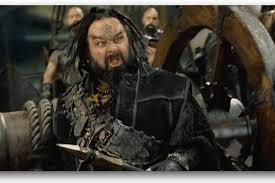
(These guys.)
This began a lengthy struggle between the two kingdoms. Just as with the fall of Arnor, an adaptation depicting the Kin-strife would show how Men’s bickering amongst each other destabilized their kingdoms and allowed Sauron to gain further power and influence over Middle-earth. Political intrigue and epic battles could be mixed with explorations of civil unrest (because that feels a little relevant right now), and provide examinations of xenophobia and racism within a fictional universe that very much needs to address that.
And it would give an opportunity to look at the humans of Middle-earth beyond Gondor and Rohan, people such as the Rhovanions and those of Umbar, the Haradrim and the Easterlings. These latter two have so far only been depicted (in both the novels and on screen) as bad dark people from mysterious (non-white) lands—but an adaptation of the Kin-strife would be an excellent opportunity to give complexity to these groups of people. They worked for Sauron, yes, but that was because their kings had been corrupted, just as much as Théoden and Denethor had been. We don’t hold all the people of Rohan and Gondor responsible for what their leaders did under that corrupting influence, so it stands to reason that those of the East and South were also stuck fighting a war they didn’t want to be in.
Further, Tolkien wrote that the Blue Wizards helped fight against Sauron in the East and South, which can be interpreted to mean that there was resistance from the Men of those lands against the dark forces. Personally, I don’t think this necessitates depictions of the Blue Wizards in a Kin-strife adaptation, but if done right it could add a fascinating component to the Istari.
The people of the East and South were just as much victims of Sauron’s evil as their lighter-skinned counterparts in Gondor and Rohan, and an adaptation that gives us their side of the conflict would be wide-reaching but also empathetic and humanizing to the Other (a treatment that The Lord of the Rings badly needs).
For further reading:
https://tolkiengateway.net/wiki/Kin-strife
https://lotr.fandom.com/wiki/Blue_Wizards
Appendix A, iv: Gondor and the Heirs of Anárion
The Shire
Despite being peaceful and reluctant to fight, the Hobbits are far from pacifists. We see this in The Lord of the Rings through the bravery of Sam, Frodo, Merry, Pippin and Bilbo. In the novels, the Scourging of the Shire proves just what happens when somebody messes with the usually peaceful inhabitants of that land. But the Hobbits have had their own share of battles to fight in the history of the Shire. They aided the kingdoms of Arnor in war against Angmar, and then later dealt with an Orc invasion so effectively that the Shire wasn’t invaded again for nearly three hundred years (and, according to legend, the game of golf was invented, thanks to what was likely the goofiest decapitation in literature). Following that, during an extremely harsh winter, the Hobbits had to deal with famine and an invasion of starving wolves that came over the frozen river looking for food. All this is to say that, for their general peacefulness and disposition toward the quiet life, the Hobbits as a people can not only handle themselves, they can do so with surprising competence, ferocity and brutality.
We deserve to see an army of Hobbits defend the Shire from Orcs, since we didn’t get the Scourging of the Shire in the films. Similarly, getting to see their resiliency during the tribulations of the Fell Winter would show us yet another facet to these people. And if an adaptation of the fall of Arnor is ever made, the founding of the Shire would need to be included as a subplot. It would make us look at the idyllic, isolated country as a place made safe not just because of its distance from the wars, but because the Hobbits and their allies have, throughout the centuries, stood up and defended themselves and their home with uncompromising courage… a sentiment that a lot of us could draw strength from, right now.
For further reading:
https://tolkiengateway.net/wiki/The_Shire
https://tolkiengateway.net/wiki/Battle_of_Greenfields
https://tolkiengateway.net/wiki/Fell_Winter_(Third_Age)
Appendix A, iii: Eriador, Arnor, and the Heirs of Isildur
Appendix B, The Third Age
What about after?
The history of Middle-earth doesn’t end with The Lord of the Rings, although it does start to wind down. Tolkien gave us some accounts of the early Fourth Age, including the fates of every member of the Fellowship. An adaptation set after the main story could give us a compelling new era to explore.
There is some precedent for this. Tolkien was actually going to write a sequel to The Lord of the Rings, set during the reign of Aragorn’s son. However, he stopped halfway through the first chapter because he found it “too depressing.”
Adapting that far into the Fourth Age wouldn’t be necessary, however, because the epic drama that followed the War of the Ring was the creation of the Reunited Kingdom. Aragorn, crowned King Elessar I, spent most of his reign reexpanding Gondor’s old borders, reestablishing Arnor, turning the Shire into a fully independent protectorate, and subduing the Easterlings, the Haradrim and the Corsairs of Umbar. This could make for an intriguing story, particularly if the wars to the East and South were portrayed as Gondor liberating those peoples from the dictators that Sauron put in place there, instead of giving us the wars of conquest that are hard not to interpret from the Appendices—nobody wants to see Aragorn subjugating native peoples. Instead, we’d have another avenue (as discussed above) for giving depth and complexity to groups of people who are marginalized in the original writings: uprisings of the Haradrim and Easterlings working in tangent with the armies of Gondor, Arnor and Rohan.
And what about the Orcs? Tolkien confirmed that, following Sauron’s final defeat, they eventually went extinct… which is dark, but Orcs were created so that they couldn’t really survive without the controlling influence of a dark lord. Diving into the final days of an entire species who, like the people of the East and South, never had a choice, could help serve as part of the much-needed, humanizing retcon that The Rings of Power is currently giving to the Orcs. This would be particularly effective if our traditional heroes have to come to terms with the fact that they weren’t killing mindless beasts, but slaves who suffered under Sauron and at these heroes’ hands. What happens when you realize that the “evil” enemy you’ve spent your life slaughtering never really wanted to fight you, and yet you helped wipe out their species? Even against a force as absolutely evil as Sauron, is such action justified? And should you endeavor to save them, following their liberation?
Further, we’d get to see the prophesied Age of Men, when humans inherit the world they won from Sauron, but a world that has lost its magic and its connection to the gods. The pain of that loss would be mixed with the excitement of a new era, and it’s not hard to imagine a complicated set of emotions being felt by many of the people alive during this time. While the darkness of the past is gone, the traditions and what comforts they had in the world of one’s youth would likely feel as irrelevant as the Elves had become in it. The world has been turned into a better place, yes, but it and its people are scarred, and still more wars must be fought to strengthen the Reunited Kingdom. Are those later wars necessary? When does the battle against pure evil devolve into wars of conquest against people who had no choice in fighting you? How far is too far to go in the name of peace?
Maybe that’s asking for too much moral complexity in this franchise, but the opportunities remain. Personally, I’m on board for anything that helps soften its inherent racism. I might talk shit about The Rings of Power, but one of the things it’s at least trying to do better is how it depicts Orcs: less as malicious beasts who revel in pillage and murder, and more as slaves who have been forced to commit atrocities. Let’s see more of this.
And let’s not forget that we have plenty of actors who could reprise their roles for a post-LotR adaptation. Viggo Mortensen returning as an elderly King Elessar? With his Queen Arwen, one of only two Elves still in Middle-earth? With the other Elf being Legolas? As Tolkien wrote in the Appendices, Legolas stuck around for a long time so that he could hang out with his best friend, Gimli, who founded a new Dwarven kingdom next to Helm’s Deep. Orlando Bloom and John Rhys-Davies might need to pick up their bow and axe again. And let’s not forget that Merry and Pippin are still around: after careers as highly respected leaders in the Shire, they retire to Minas Tirith and live out their last years with their old friend, Aragorn. Half the cast is already there.
Okay, this last one is a pipe-dream, but going off the nostalgia factor alone, it’d be an awesome watch. LotR requel? Or Tolkien’s unfinished sequel, brought to life?
For further reading:
https://tolkiengateway.net/wiki/Reunited_Kingdom
Appendix B, Later Events Concerning the Members of the Fellowship of the Ring
For further viewing
These Youtube channels are some the best places to find easy to digest breakdowns of LotR lore from the novels, Appendices and deeper writings like The Silmarillion and Unfinished Tales:
https://www.youtube.com/@NerdoftheRings
https://www.youtube.com/user/kscerri
https://www.youtube.com/channel/UCxoxXCaHRY5z0K3hhkxDxNg
Photo credits
Enchanted Realms of Middle-earth: A Fantasy Awakening (step.o.metal, alphacoders.com)
Reddit r/MovieDetails
 John Stadelman
Leave a comment