
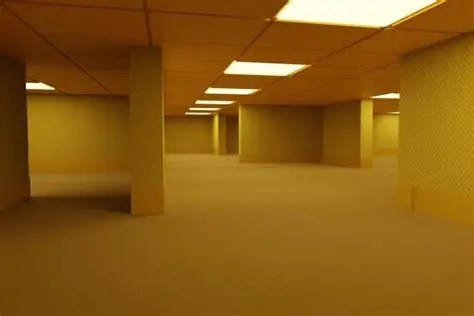
Spoilers for Backrooms ahead.
The Place That Shouldn’t Exist
The first time saw this image—
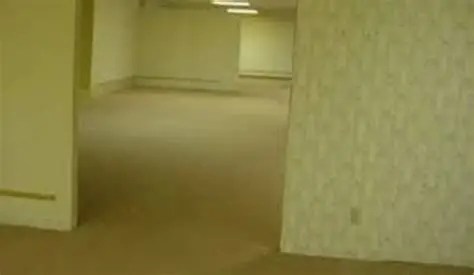
—I picked up on the dread and unease that so many comments expressed. This was aided by the explanations, brief and ominous, of the nature of this place. If you were unlucky, you might take the wrong turn, walk through the wrong door, or even straight through a wall, and step into an empty room. Ugly yellow wallpaper, dull carpet. The continuous hum of fluorescents. Beyond this room stands another room, ugly and yellow under the hum. Beyond that room, another. And another, onward, forever. The Backrooms.
An infinite place in a finite universe, of incalculable monotony and an emptiness that is never filled. Standing outside of reality, its existence speaks to a breakage in what should be, outside of the parameters of the universe we know and how it should work. Even if it could be studied, theorized and eventually understood—the explanation might be something we can never come back from.
This is how I first saw the Backrooms. The simplicity of that photo has its own stark elegance, and the internet lore early on left more questions than answers. If a place can be entered in a way that defies the laws of physics, then how is this place still bound to those laws? What function could it serve? Does it have one, or is it a mistake? A glitch in reality, then, matter replicating endlessly from misread instructions? If that latter is the case, then the universe really must be a simulation, something that you can noclip out of, and get lost inside its blue hell.
But if the universe isn’t a simulation… then how could something like this exist? If reality has the potential to break, if particles can arrange themselves incorrectly, creating a space that lies outside of the rest, then what’s stopping it from doing that at any given moment? What if it can happen to anyone, at any time? How can you avoid it? Or stop it?
Can you?
Or are you lost, to roam the yellow monotony until starvation takes you, leaving a skeleton in one single room, one finite point, among the infinity?
That scared the hell out of me… until the internet started adding monsters to fill the uneasy emptiness. And then came new levels, new environments that break up the monotony and thus destroy the effect. Then Backrooms gave the most widely-recognized interpretation: that this place exists in conversation with the mind of anyone who enters, taking from their subconscious in an attempt to recreate it, to copy reality—but it fails.
In so doing, the lore of the Backrooms has gone along a notably different route than the breakage in reality first suggested by the original post. This is fine, especially since so many people have not only come to enjoy the complex lore but actively contribute to its development (making it a communal, democratic work of art). Still, I hold to how I first saw it: as a liminal space whose unfilled existence displays just how little humanity knows about the universe. That was when the Backrooms scared me: when it was cosmic.
Even though I would have plotted Backrooms differently, I did thoroughly enjoy it. And while I feel like it did an excellent job with the interpretation of the Backrooms as a product of the warped human mind (scaring us while commenting on everything from capitalism, AI and toxic masculinity) I want to think about a different interpretation of the Backrooms, and of liminal spaces in general… not as solipsist environments that interact with the human presence, but instead as places that exist regardless of humans… as breakages in reality, the liminal cosmic.
Liminal Cosmic Horror
Think of it like that.
Liminal, because this place rests in the uncanny valley of human perception as normal, but not normal enough. Like dolls and masks, the Backrooms are recognizable (empty rooms) but their emptiness and endlessness unsettle us because rooms shouldn’t be empty and they shouldn’t stretch on forever. This takes the preexisting expectation of filled space and deforms it into anxiety and dread over the fact that it isn’t filled. This is the true horror of the Backrooms: eternal emptiness.
It’s cosmic, because the existence of a place outside of reality (but still bound to some of the laws of physics) is evidence that the universe is far larger than humanity has thought… and possibly outside of our ability to understand. If the universe can’t be understood, then it can’t be predicted; and if it can’t be predicted, then it can’t be defended against. This is the same core principle of Lovecraftian horror. Cthulhu’s very existence speaks to dimensions of reality far beyond human comprehension, because if this thing can exist despite our inability to understand it, then we are far smaller and more powerless than we knew, than we can even guess at.
In this sense, Cthulhu and the Backrooms are the same: representations of an incomprehensible reality.
Under this interpretation, the human mind has no influence here. It can’t bring itself into the Backrooms and affect it, can’t create new rooms and distorted copies of itself and those who it holds in its memories. For all the freakishness of Captain Clark and the other simulacrums of real people, they still allow the mind that made it power over the Backrooms because that mind can affect what is made in it. The sicker the mind, the more horrid the creations—which is a frightening concept, but it can be fought against because that mind can be removed from this version of the Backrooms, taking the danger away with it. And perhaps, through trial and error, a determined mind could even manipulate it.
In short, there’s a way to fight back, to survive. A way to have power over the universe.
But if the Backrooms are the liminal cosmic—if they are environments vaguely familiar but not built for us, existing with or without human presence, and can’t be altered by a conscious mind—then there’s no power to be had over it. A sick mind affecting the Backrooms can be removed from the environment, but a hostile reality can’t be altered. It will continue on, as it always has; we can’t do anything about it, and no action we take will affect it. Just as humanity is a primate species living on a waterlogged rock in a backwater of a backwater in the vast universe, a person trapped inside the liminal cosmic Backrooms is a brief speck of motion in a still world, a limited thing in a ceaseless expanse, destined to come to an end amid the endlessness.
And that endlessness will continue on, in both space and time, unaffected. Just like how the universe, potentially without end and devoid of objective meaning, will stretch onward forever, regardless of us.
Endless emptiness.
Hell is Monotony
No wonder, then, that we filled the Backrooms with monsters.
It had to be filled, because the emptiness disturbs us. A room, unlike an empty field or a desert, was constructed. It’s meant serve a function; there’s no such thing as a room that has no purpose. The human mind can’t stand these purposeless rooms, and so the internet began to fill them—with architectural variation, and with life.
That life is, of course, dangerous. Because what else would live in such a fundamentally wrong place? Only monsters, mysterious and hostile, that could be lurking around the next corner… or that might be watching you from the shadows just beyond the fluorescents’ reach.
Something concrete.
Because no matter how terrifying this thing is:
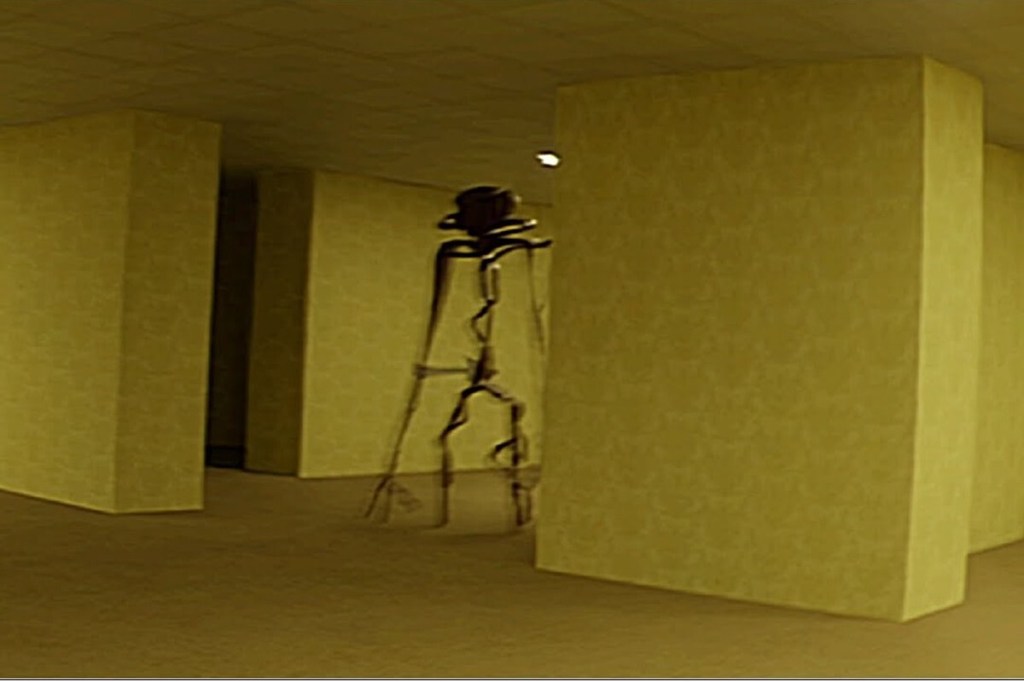
—at least it’s physical, tangible. It consolidates our formless dread into an object that we can latch our fear onto. Now that we know the threat, we can fight it. And now the rooms have gained purpose: as the environments in which these monsters roam, hunt and kill.
This renders the Backrooms into something understandable to the human mind, moving it further away from the liminal cosmic and into the liminal concrete. But it also gives the creators of the expanded Backrooms lore power over the concept. They filled the fictional emptiness because we can’t stand the real emptiness that it shows us.
And they added more levels—the pool, the playpen—because our brains aren’t wired for monotony. At a biological level, we need novelty and variety, a continuous input of changing stimuli. Charlotte Perkins Gilman certainly understood this when she wrote “The Yellow Wallpaper.” It’s interesting that the Backrooms share the same color, which I don’t think is intentional. A crucial part of what made the original photo so eerie was its dull coloration, suggesting rot and sickness. In a certain interpretation, the Backrooms can be read as the bedroom-prison of “The Yellow Wallpaper” expanding into infinity.
For brains that need constant, variating stimuli, the unchanging is torture. Hell is monotony.
And confronted with Hell, we filled it with monsters, so that we could live there.
Cover photo credit: scitechdaily.com


Leave a Reply